15 October 2013

INature: new birds (to me) for 2013

IN an effort to keep this new blog series, and blog, wonderfully lame and unhelpful, here are some photos I poached from Google Images. I added eight birds to my list this year, mostly just on accident, by sheer virtue of being outside for substantial chunks of time with my eyes and ears open, which I highly recommend. I'm up to about 265 birds, depending on how you count 'em, and I've still seen more in 18 months of living in Bolivia than a lifetime in Indiana/Michigan. Nine of them I spotted in both continents, which was a weird feeling.


Ruffed grouse. Saw this guy in a youngish deciduous/pine forest in northern Lower Peninsula Michigan. Heard him first... it stopped me running, dead in my tracks, and for a brief instant I couldn't tell whether it was a grouse or my beating heart. Loved that.

Saw a Northern Harrier fly by while riding in a car. ID'd by my professor, who noticed that white rump, and the fact that it was cruising low to the ground. It is always surprising to me how easy it often is to identify a species by a very distinct habit, habitat, or coloration. When you spot a bird, quickly note the most striking coloration, and strange shape or flight pattern. Remember that habitat as well, and you're well on your way. In the guide books, it will say something like (for another bird) "These little bugger are seen running frantically on the shoreline, nervously bobbing their tails." Sure enough - ID'd him.


You can actually hunt these guys, which must be fun, if not insanely difficult. Woodcocks burst off the floor when you are just about to step on them. They have an amazing courtship ritual which I have never seen, though the description by Aldo Leopold is beautiful in itself. Don't confuse them with the next bird...
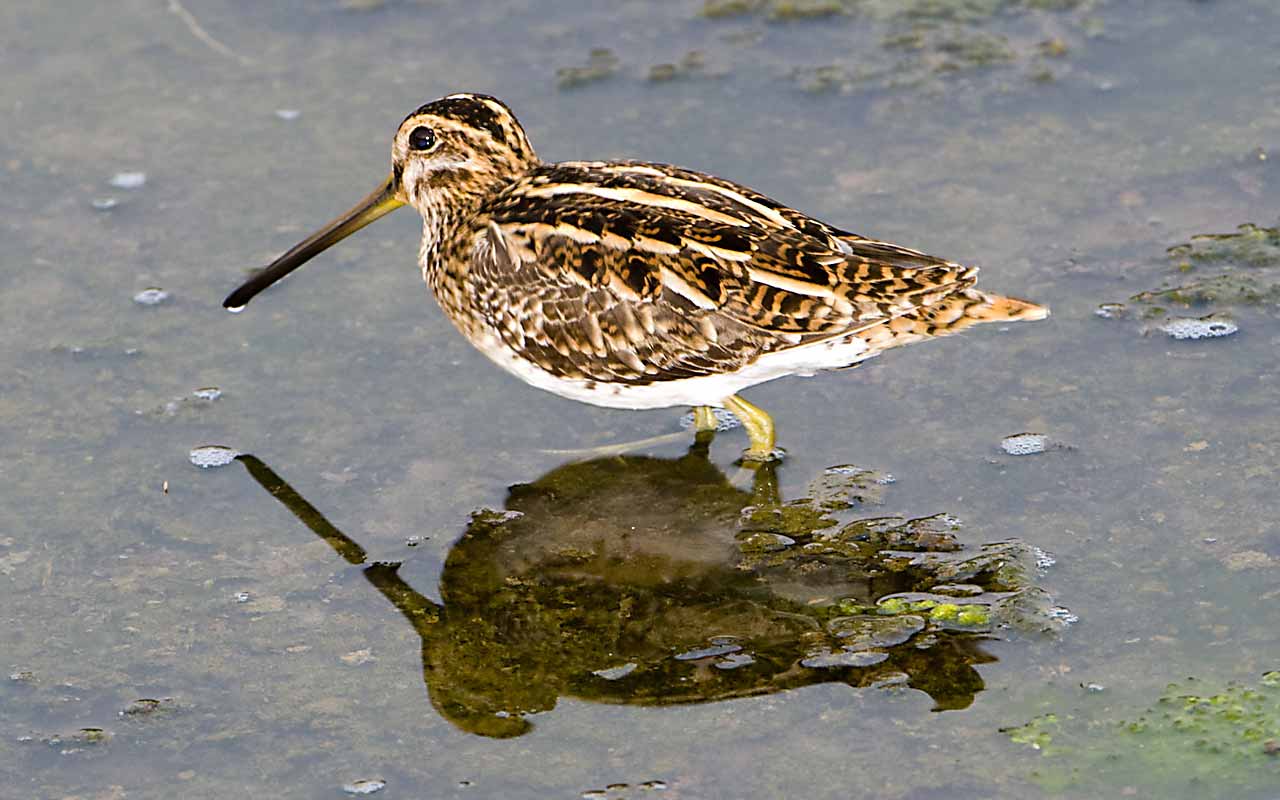
Yes, Virginia, you really can go Snipe hunting. A similar burst-from-the-ground escape tactic, but a more marshy habitat, different coloration, bill, etc. You'd have to be a really good shot... where do you think the term "sniper" came from, eh?


Saw this beautiful Bufflehead this spring on its migration northward. He was just chillin' on Taylor Lake (campus), but he must have been through a hunting season or two, for he took off as soon as he sensed my presence. With the help of a few friends, I figured out what I had seen.


Rails, like this Sora, are usually impossible to see, though you may hear them calling at the marsh, tucked away invisibly in the cattails. I scared one up and it only puttered away about 20 feet behind a couple cattails, allowing me a long gaze. Maybe I was right next to the nest? I did spot a cute all-black chick darting between some vegetation.


Again, I noted just a couple observations about color and behavior and the guidebook did the rest. Solitary Sandpiper, feeding on the exposed mudflats of a reservoir, southbound. Granted, this seemed to me more difficult in Bolivia, where you are faced with perhaps a half dozen varieties instead of, say, just two likely candidates.


Greater Yellowlegs. At the same mudflat I saw the sandpiper in. Another migrant.


Ok, I know these are birds that experienced birders picked up on their 3rd grade field trip, but it was fun to add a few to the list without even trying too hard. Luckily, my work puts me out of doors for hours at a time. Poor compensation, but this made up for it!

03 October 2013

INature: The Paw Paw (Asimina triloba)

Time to get your foraging on... it's paw paw time!

I just introduced a couple friends to this wonderful native tree (via some fruit); like many, they couldn't believe that it grew wild in Indiana. The paw paw is not difficult to spot. It has simple leaves nearly a foot long, with smooth edges ("entire margins," having no teeth). Like me, you might first confuse it at some distance with a hickory, which has compound leaves. The Paw paw is an understory tree than doesn't seem to grow much more than 30 feet tall. Whenever you see a paw paw, look around you - there are almost certainly several more plants, since they reproduce by root suckering more-so than seed production.

The paw paw feels a little out of place this far north. It produces the largest edible fruit indigenous to the U.S. and both the fruit and leaves seem "tropical." The soft fruit tastes something like a banana-mango custard. Yum! Wait to pick until they are feeling a little soft on the outside. If you have to pull very hard to get them off the tree, it's too early. If you do catch some unripe fruit, try leaving them at room temp for a few days. They might yellow a little bit upon maturation, but all the fruits I've found this year have been fully ripe and still very green looking. You should be able to peel off the skin with your bare hands, which can be discarded.


I have purchased young seedlings on eBay and both of them put out leaves the first year. If you, dear reader, are interested in planting some trees of your own, I have been savings dozens of paw paw seeds from this years crop. I have read here (Kentucky State U. Planting Guide) that are somewhat tricky to germinate, but it hurts nothing to try.  Please e-mail me if you'd like some seeds! However, this won't bear fruit for several years, nor will it likely be prodigious. But with this pleasant native oddity, the fruits are icing on the cake; you can forage for more paw paw patches in the meantime, carefully making notes for future harvests.


Of course the most important reason to forage paw paws is that it's yet another excuse to get out in the woods! I usually prefer the much higher chance of being "fruitful" with my paw paw "hunt" than the hours and hours I spent last fall waiting for venison. There are nearly 5,000 acres of woods where I work. From what I can tell nearly nobody even knows about them. That must be why I've hauled out several dozen fruits already!

But don't delay. It's a limited-time offer than won't return 'til our next lap around the star!