15 October 2013

INature: new birds (to me) for 2013

IN an effort to keep this new blog series, and blog, wonderfully lame and unhelpful, here are some photos I poached from Google Images. I added eight birds to my list this year, mostly just on accident, by sheer virtue of being outside for substantial chunks of time with my eyes and ears open, which I highly recommend. I'm up to about 265 birds, depending on how you count 'em, and I've still seen more in 18 months of living in Bolivia than a lifetime in Indiana/Michigan. Nine of them I spotted in both continents, which was a weird feeling.


Ruffed grouse. Saw this guy in a youngish deciduous/pine forest in northern Lower Peninsula Michigan. Heard him first... it stopped me running, dead in my tracks, and for a brief instant I couldn't tell whether it was a grouse or my beating heart. Loved that.

Saw a Northern Harrier fly by while riding in a car. ID'd by my professor, who noticed that white rump, and the fact that it was cruising low to the ground. It is always surprising to me how easy it often is to identify a species by a very distinct habit, habitat, or coloration. When you spot a bird, quickly note the most striking coloration, and strange shape or flight pattern. Remember that habitat as well, and you're well on your way. In the guide books, it will say something like (for another bird) "These little bugger are seen running frantically on the shoreline, nervously bobbing their tails." Sure enough - ID'd him.


You can actually hunt these guys, which must be fun, if not insanely difficult. Woodcocks burst off the floor when you are just about to step on them. They have an amazing courtship ritual which I have never seen, though the description by Aldo Leopold is beautiful in itself. Don't confuse them with the next bird...
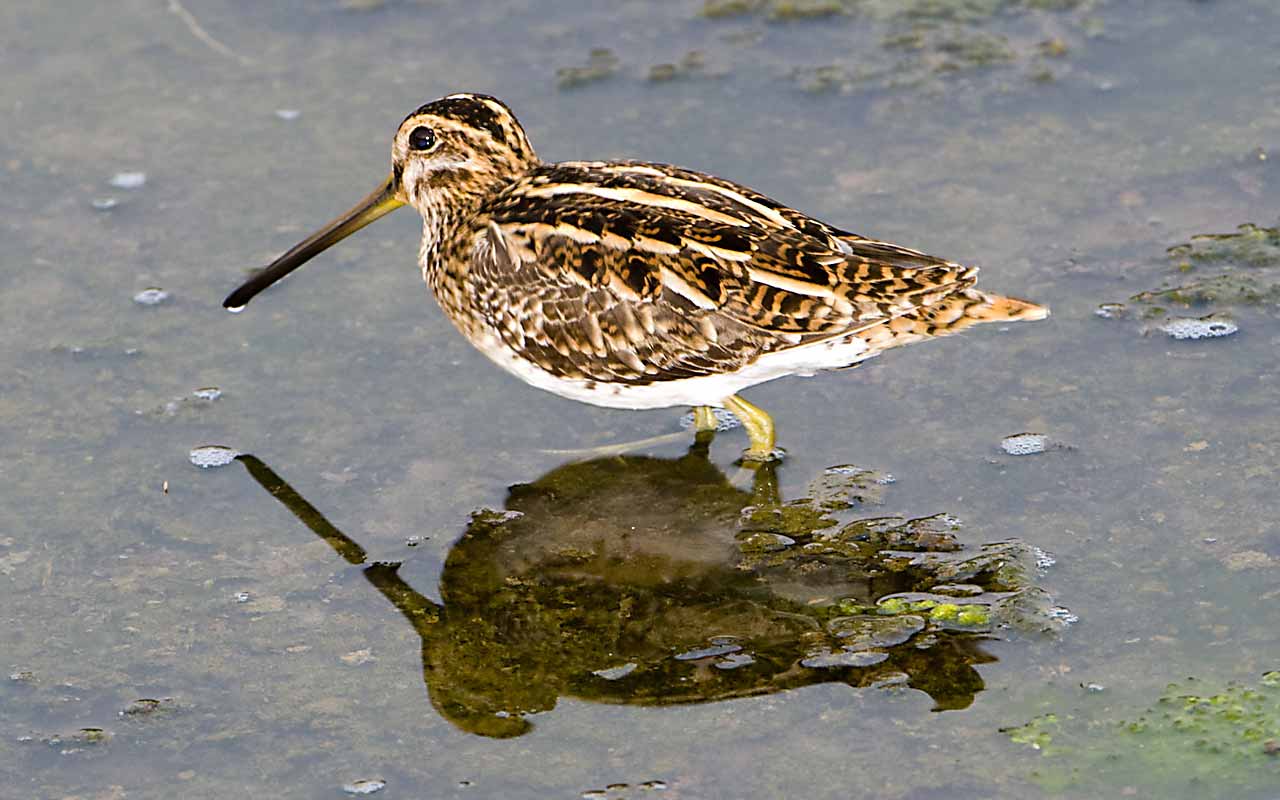
Yes, Virginia, you really can go Snipe hunting. A similar burst-from-the-ground escape tactic, but a more marshy habitat, different coloration, bill, etc. You'd have to be a really good shot... where do you think the term "sniper" came from, eh?


Saw this beautiful Bufflehead this spring on its migration northward. He was just chillin' on Taylor Lake (campus), but he must have been through a hunting season or two, for he took off as soon as he sensed my presence. With the help of a few friends, I figured out what I had seen.


Rails, like this Sora, are usually impossible to see, though you may hear them calling at the marsh, tucked away invisibly in the cattails. I scared one up and it only puttered away about 20 feet behind a couple cattails, allowing me a long gaze. Maybe I was right next to the nest? I did spot a cute all-black chick darting between some vegetation.


Again, I noted just a couple observations about color and behavior and the guidebook did the rest. Solitary Sandpiper, feeding on the exposed mudflats of a reservoir, southbound. Granted, this seemed to me more difficult in Bolivia, where you are faced with perhaps a half dozen varieties instead of, say, just two likely candidates.


Greater Yellowlegs. At the same mudflat I saw the sandpiper in. Another migrant.


Ok, I know these are birds that experienced birders picked up on their 3rd grade field trip, but it was fun to add a few to the list without even trying too hard. Luckily, my work puts me out of doors for hours at a time. Poor compensation, but this made up for it!

03 October 2013

INature: The Paw Paw (Asimina triloba)

Time to get your foraging on... it's paw paw time!

I just introduced a couple friends to this wonderful native tree (via some fruit); like many, they couldn't believe that it grew wild in Indiana. The paw paw is not difficult to spot. It has simple leaves nearly a foot long, with smooth edges ("entire margins," having no teeth). Like me, you might first confuse it at some distance with a hickory, which has compound leaves. The Paw paw is an understory tree than doesn't seem to grow much more than 30 feet tall. Whenever you see a paw paw, look around you - there are almost certainly several more plants, since they reproduce by root suckering more-so than seed production.

The paw paw feels a little out of place this far north. It produces the largest edible fruit indigenous to the U.S. and both the fruit and leaves seem "tropical." The soft fruit tastes something like a banana-mango custard. Yum! Wait to pick until they are feeling a little soft on the outside. If you have to pull very hard to get them off the tree, it's too early. If you do catch some unripe fruit, try leaving them at room temp for a few days. They might yellow a little bit upon maturation, but all the fruits I've found this year have been fully ripe and still very green looking. You should be able to peel off the skin with your bare hands, which can be discarded.


I have purchased young seedlings on eBay and both of them put out leaves the first year. If you, dear reader, are interested in planting some trees of your own, I have been savings dozens of paw paw seeds from this years crop. I have read here (Kentucky State U. Planting Guide) that are somewhat tricky to germinate, but it hurts nothing to try.  Please e-mail me if you'd like some seeds! However, this won't bear fruit for several years, nor will it likely be prodigious. But with this pleasant native oddity, the fruits are icing on the cake; you can forage for more paw paw patches in the meantime, carefully making notes for future harvests.


Of course the most important reason to forage paw paws is that it's yet another excuse to get out in the woods! I usually prefer the much higher chance of being "fruitful" with my paw paw "hunt" than the hours and hours I spent last fall waiting for venison. There are nearly 5,000 acres of woods where I work. From what I can tell nearly nobody even knows about them. That must be why I've hauled out several dozen fruits already!

But don't delay. It's a limited-time offer than won't return 'til our next lap around the star!


21 September 2013

INature: Parasites happen

Ok, 3 weeks behind already. Not sure if I'll have/make time enough to do this INature thing the way I'd like. Oh well...

Parasites are everywhere. Well... there are lots of mutualisms too & they don't get a lot of love, so let's not be too grim. But if it bleeds, it leads, right?

I found this splendid caterpillar near a marsh, munching on some Swamp Milkweed. With the aid of WhatsThatBug.com I found out that it was the Smeared Dagger Moth Caterpillar. Turns out to be a pretty nondescript moth, but I thought it's Latin name was neat: Acronicta oblinita.


I found another one a couple weeks later and decided to bring it home to my daughter.


We had previously cared for a Monarch chrysalis and watched it change from green to clear (it emerged while we were at church).


All was well for awhile. I had found it on a willow sprout and it munched away contentedly. Then we ran into some problems (sorry for the poor pictures... a perennial problem of mine).


I detailed them to WhatsThatBug.com:
... It stopped moving completely and even starting spinning a strange web. To my wife’s horror, dozens of small yellow parasites slowly emerged from its side as it was still (apparently?) alive. They all seemed to perish in the hot sun and the ants had a feast. Photo attached. I searched Google Scholar for some clues…
I see a 1903 reference to a ”Rhogas rileyi Cress” being parasitic, mentioning the silk I saw (p. 24 here: http://bit.ly/1atDh3W). However, I cannot find R. rileyi Cress in recent mention so I wonder if the name has been updated. I see a recent publication noting that the parasitic wasp Aleiodes rileyi Cresson often chooses A. oblinita as a host, but it did not seem to undergo the mummification described.

I received a prompt reply:

 ... in our opinion, the parasites that emerged from the Smartweed Caterpillar look more like fly larvae to us, so with that in mind, we would lean more toward this being an instance of parasitization by Tachinid Fly.  We have not been able to uncover any evidence, and that is just our first impression.  Perhaps one of our readers will have better luck determining What Parasitized the Smartweed Caterpillar?
So it was indeed a biology lesson... just not the one we expected! Raising caterpillars is supposedly quite simple. So far, we're about 1 / 5, and that was starting with a chrysalis.


29 August 2013

INature: Biodiversity

biodiversity (or "biological diversity")
    -the variety of life in the world or in a particular habitat or ecosystem
   -degree of variation of life forms within a given species, ecosystem, biome, or planet


Let everything that has breath praise the Lord. (Ps. 150:6)

.    .    .

I caught this bumblebee hovering over this unknown plant.
Considering biodiversity from a scientific perspective, it is the foundation for what we consider healthy, whole, natural systems. Biodiversity implies resilience, flexibility, complexity in the face of changing climates, invasive species, and stochastic events. If there are more species in the mix, it is less likely that any given event or change will fundamentally change or damage a particular system. The chestnut blight of the 20th century and Emerald Ash Borer infestation now spreading across Indiana are not to be celebrated, but the forests themselves will (generally) be okay in the long term. There are still many species of trees to provide cover, food, water filtration, and erosion control. Losing an entire forest to development or agriculture is far more detrimental than to lose a single species. This is why it is recommended that people plant a diversity of tree species in homes and public places. We cannot predict the next big disease, so we hedge our bets with biodiversity.

Besides all the birds and the bees that thrive in biodiverse systems, a human-centered, utilitarian perspective also shows that they are vitally important. They provide ecosystem services that we won't ever be able to fully engineer our way around. Natural cover (say, prairie or forest) allow much greater groundwater infiltration than bare agricultural soils, and certainly more than impervious surfaces. It also is worthwhile to point out the obvious: we chose from the incredible diversity of wild plants and animals to build a library of domesticated species for food, fuel, and fiber. Also, we know that we breathe out carbon dioxide, which photosynthetic organisms use as building blocks for sugars and such, spitting out oxygen as a by-product. Kind of handy, since that's what we need to breathe in every few seconds.

A thirsty butterfly licks up salt from my sweaty hand (I think)
Aesthetically and culturally, biodiversity is variety. It is "the spice of life." Vast fields of Zea mays may be beautiful to the indebted farmer, or the starving peasant, but we generally don't travel great distances to see even larger fields of a single species. We like variety, patchwork amalgams of colors and textures. Even the iconic images we hold of family farms (which have by-and-large been outdated for decades) show a diversity of animals, fields of multiple crops broken up by fence rows, ponds, outbuildings, and windmills.


And the diversity is stunning. 3.5 billion years of evolution, tectonic plates, climate change, and meteors have bequeathed us some 10 million species. We've only formally cataloged about 12% of that.


Another one of the 100,000+ kinds of insects native to N. America.
We have Monarch butterflies making a multi-generational migration from Canada to Mexico, sometimes over the Gulf of Mexico.

Black swallowtail (Papilio polyxenes) caterpillar found on our dill plant.
We have the Arctic tern, a 3.5 oz flying package of feathers who flies more in a single year as most American will probably walk in their lifetime - 44,000+ miles.

We have microorganisms deep in the Earth that will never see the sun, yet do just fine with chemosynthesis, earning a living straight from hydrogen sulfide.


North America used to be (until ~10,000 years ago) home to a cheetah, a lion, mammoths, horses, sloths and beavers the size of black bears, and a 9-foot-long sabertooth salmon.

If that doesn't get your blood moving, I'm at a loss at how to help. I'll just suffer the strange looks and go about my business.

Yeah, I know. It doesn't make sense.
The best way that I can think to celebrate this heritage is to name it, know it, explore it. 

In other words, to be like Adam.


Aldo Leopold wrote in his must-read book on ecological restoration, A Sand County Alamanac 
If I were to tell preacher of the adjoining church that the road crew has been burning history books in his cemetery, under the guise of mowing weeds, he would be amazed and uncomprehending. How could a weed be a book?
My effort here with "INature," and in my professional career and parenting, is to explore this vast natural library, book by book.


And like all great pursuits, this joyful enterprise is tinged with more than a bit of sorrow. Leopold also wrote:
One of the penalties of an ecological education is that one lives alone in a world of wounds. Much of the damage inflicted on land is quite invisible to laymen. An ecologist must either harden his shell and make believe that the consequences of science are none of his business, or he must be the doctor who sees the marks of death in a community that believes itself well and does not want to be told otherwise.
It's taken my about three decades to realize that bitterness, cynicism, and name-calling are no way to live, even if you happen to be right now and then. It's no way to do a family, or a church, or a business. I have to constantly remind myself of that. No matter where we are starting from, a better dawn is always possible.

Weeping may endure for a night, but joy cometh in the morning.  (Ps, 30:5)

And thankfully, the sun has risen for me over 10,000 times.


And now, time for my Plant Taxonomy lab...
 

19 August 2013

"INature": A new blog (series)

The blog wasn't dead, it was just dormant.

I'd like to cover little episodes of my wanderings in nature ("INature"), highlighting one natural process or species at a time, usually with a picture. Recently, I started some temp work in a natural setting, so I've lots of opportunities for these observations. They're a part of my job now. As long as I keep my eyes and ears working, I learn something every day. It's in the exchanges, questions, and ponderings that learning happens. There will be many unanswered questions... I'm counting on you to help me solve them!

If you want much better coverage of all things natural and Hoosier, you'd best check out Outdoor Indiana magazine. For each publication, they have a small write up one two Hoosier species, and I'd like to copy that feel.

So until I have time to sit down and write about the dozens of pictures I've already taken, I'll leave you with a marshy mystery...


16 June 2013

air conditioning compels you

The Unabomber writes that society evolves irrationally, which is probably how he justified mailing people bombs. But what would a rational society look like/ He never explains that part.

When it's warm out, I like to sit inside air-conditioned rooms. This feels rational to me. it seems rational to want to be comfortable. But is it rational to expect to be cool when the outside temperature is 95 degrees? I suppose it isn't. But why would it e irrational to build and use a machine tht makes things cooler? Here again, that seems rational.

Yet what am I giving up in order to have a 70-degree living room in July?

Nothing that's particularly important to me.

For the air conditioner to work, I need to live in a building that has electricity, so I have to be connected to the rest of society. That's fine. That's no problem. Of course, to be accepted by that society, I have to accept the rules and laws of community living. That's fine, too. now, to thrive and flourish and afford my electric bill, I will also have to earn money. But that's okay - most jobs are social and many are enriching and unnecessary. however, the only way to earn money is to do something (or provide something) that is valued by other people. And since I don't get to decide what other people value, what I do to make a living is not really my decision. So - in order to have air-conditioning - I will agree to live in a specific place with other people, following whatever rules happen to exist there, all the while working at a job that was constructed by someone else for their benefit.

In order to have a 70-degree living room, I give up almost everything.

Yet nothing that's particularly important to me.

When [Ted] Kaczynski wrote, 'Technology is a more powerful social force than the aspiration for freedom,' I assume this is what he meant.
from the essay FAIL in Eating the Dinosaur by Chuck Klosterman

05 June 2013

Spring

These photo composites are from 4/26, 5/8, and 6/5. 
  
The purple coneflower perimeter was a gift from some unknown previous tenant. Going strong. We added herbs, green beans, and some transplanted wildflowers. A hummingbird keeps returning to this pink flowering plant... not sure what it is. Of course, everything is already too crowded... I still don't have faith that little seeds can growth so much, so fast.


We dug up a small strip of grass and added some potting soil, composted manure, and decomposing litter from a stick pile.


 Bloodroot (Sanguinaria canadensis)

 Snap pea blossoms

First coneflower of the year (Echinachea purpurea), found by the Tiger Swallowtail (Papilio glaucus).


There it is!

03 May 2013

at Dot Earth blog: "An Earth Scientist Explores the Biggest Climate Threat: Fear"

Andy Revkin at the irreplaceable "Dot Earth" NYT blog recently posted this reflection by Peter B. Kelemen, the Arthur D. Storke Professor and vice chair in the Department of Earth and Environmental Sciences at Columbia University.

Kelemen really puts into words my sentiments in regards to climate change. To me, it captures the proper attitude we should have towards science: a confident, yet not infallible view of the world around us. Especially in regards to projecting the future (climate science, and as I've learned, conservation biology), we must be humble, driven as we are by critical thinking and helpful models. And even in the face of real and present threats to both beautiful human and non-human creatures, to always maintain hope.

The future is unknown. Make it a good one.
Fear Itself
We already know it is too late to reverse the planet’s transformation, and we know what is going to happen next – superstorms, super-droughts, super-pandemics, massive population displacement, water scarcity, desertification and all the rest. Massive destruction, displacement and despair. Our worst fears are already upon us. The reality is far worse than anyone has imagined.”

These phrases are distilled from “Writing at the End,” an essay by Nathaniel Rich in Sunday’s New York Times Book Review. They capture its doomsday ethos, and its breathtaking certainty. Rich, a novelist, is sure he knows the causes of our present ills, and the nature of the near future. He probably feels that he learned this from the 98 percent of climate scientists who – famously – agree on some things. I am part of that community; we agree that human greenhouse gas emissions are having a huge, negative effect on global climate. But I don’t agree with Nathaniel Rich.
Apocalyptic warnings sell newspapers, power Web sites, and are surprisingly good for marketing. Beyond the media, in the sciences and social sciences, if your research predicts a scary outcome, your name gets in the news, your grants get funded, and you feel like Paul Revere (though you might be Chicken Little). It’s a heady experience.
Meanwhile, my children are fearful of, and almost paralyzed by, the prospect of an inevitable, dystopian future. They would like to contribute to avoiding calamity, but they don’t see where to start, and they are told it is too late to begin. And my children are lucky, in a stable home, among the 3 percent, talented, athletic, well educated. In the face of an overarching climate of fear, people with less opportunity find there is nothing they can do to help avoid “destruction, displacement and despair.”
However, climate catastrophe is not inevitable, let alone irreversible. Of course, it could happen. It is logical to expect that, as atmospheric greenhouse gases increase and the world warms up, the extra energy in the atmosphere and oceans will move things around in unusual ways for which we are not prepared. The costs will likely be very high. We should work to avoid this, for simple, practical reasons.  Avoiding emissions now will be far less expensive than capturing carbon dioxide from air in the future. But the future is unpredictable, our mistakes are correctable, and there is plenty of reason for optimism about what people can accomplish in the face of necessity.
Throughout the past 10 to 20 years, despite many obstacles, worldwide wind and solar energy generation have grown exponentially, at more than 24 and 33 percent per year, respectively. They still constitute a small share of total energy production – not surprisingly, since they still cost more than other sources. A carbon tax would help to even the playing field, factoring in the likely damage due to greenhouse gas emissions. This is overdue. But my point here is that, despite the obstacles, some segments of society are sufficiently farsighted to invest in the future, even at a present-day premium. It is happening.
The current boom in natural gas production, based on hydraulic fracture, is fiercely opposed by many environmentalists. It’s true that low gas prices are endangering segments of the renewable power industry in the United States. Carbon dioxide emissions from burning gas are a fraction of those from coal combustion, but gas wells and pipelines leak, so it’s not clear whether switching to gas really reduces greenhouse emissions. However – even including the cost of carbon capture and storage – the U.S. Energy Information Administration’s 2012 Annual Energy Outlook predicts that five years from now gas-fired power will be less expensive than wind, and about half the cost of state-of-the-art solar power. [All the reports are here.]
Gas-fired power plants are a nimble addition to the overall energy grid. They are relatively easy to switch on and off, compensating for asynchronous variation in wind speed and sunlight on the one hand, and power consumption on the other. And the increasing supply of home-grown hydrocarbons is changing the global strategic picture in positive ways. All of these topics are debatable, but it is wrong to portray the discussion as a contest between good and evil, or assert that the pro-gas path will inevitably lead to disaster. No one can know all the answers.
In coming years there will be plenty of big storms and deep droughts. They will come in unpredictable clumps, like the giant earthquakes that have been unusually frequent in the past decade. In the midst of this natural chaos, it is hard to discern whether the long-term frequency of destructive events is really increasing or not, and why. In the popular imagination, especially in this country, when something bad happens, someone is always to blame. But in the real world, stuff happens.
Over time, we will find out what will happen. As the costs and dangers of present trends become clear, people will react. Virtually the entire oil and gas industry was built in a century. Half of it has been constructed since 1980. Think of what we, and our children, can accomplish in the next century, starting with the next 30 years. I am optimistic about this. Climate, energy, and resource problems have solutions, and we can solve them when we muster the resolve to do so. This requires a costly commitment, which will only be made if most people believe a positive outcome is both attainable and worthwhile.
Therefore, the climate that worries me most is the climate of fear, the belief that our current trajectory leads inevitably to total disaster. This belief discourages constructive action, and can result in irrational acts by people in despair, individually, or as nations, willing to do anything to derail the juggernaut we are told is carrying us, inevitably, to destruction. Unlike environmental problems, it is less clear to me how we change this. But at least, those of us in science, social science and the media can seek to craft solutions and enlist engagement, rather than feeding fear. With hope comes action.

22 April 2013

Earth Day lesson - watersheds

I guess my ambivalence (or cynicism) towards Earth Day is summed up mostly by Joe Romm's post at Climate Progress.

I don’t worry about the earth. I’m pretty certain the earth will survive the worst we can do to it... Arguably, concern over the earth is elitist, something people can afford to spend their time on when every other need is met. But elitism is out these days. We need a new way to make people care about the nasty things we’re doing with our cars and power plants. At the very least, we need a new name.
Yes, the Earth will keep on spinning. I'm not worried that we're about to prevent this huge rock from wheeling madly around its star. But what is demonstrably true, and what must be repeated over and over again to counter lies to the contrary, is that we've caused many species to go extinct, we've disrupted entire ecosystems, and we've changed the climate. There is no frontier left. We are 7 billion strong, and we're everywhere.

Base camp on Huayna Potosi, Bolivia. Photo by Andy Baker

Does it matter on a planetary scale whether I have one child or three? Not at all. It would change the world population by less than 1 millionth of 1%. Unless we are one of those one-in-a-million movers or shakers in positions of authority (CEOs, lead scientists, policy makers, etc), each of us has virtually no impact on a global scale. This was captured in a book entitled "But Will the Planet Notice?" (accompanying article). Summary: policies are the overwhelming factor in global environmental trends.

The first Earth Day appears to have been a true grassroots movement, but now it is a somewhat theoretical celebration coordinated by big NGOs, socially-conscious corporations, and lots of Facebook "likes" for green things.

Heartening, no?

Well, here's an excerpt from an e-mail I received from The Stewardship Network that maybe better explains what I'm feeling, and what the solution might be...
Our lands and waters are undergoing quieter crises that are equally significant and pressing. Maybe you're driven to protect our diverse, native wildflowers from being lost to invasive plants, or maybe you're driven to protect the insects who depend on those wildflowers for food and in turn pollinate our food crops. You may work to protect the quality of your local watershed, or the larger natural community of which those flowers, insects, and watersheds are integral pieces.

Here's the thing: these crises are not separate. Oil spills, climate change, the spread of invasive plants, the abuse of watersheds... they're all symptoms of the same problem: people have disconnected their actions from the their impacts on our planet.

The Stewardship Network rebuilds these connections; equipping people with tools, resources & knowledge; and mobilizing people to get out and make a positive difference. Your actions to care for your local parks, your own backyard, and the landscapes you grew up in are important steps in reconnecting yourself and those around with the Earth.
So let's get real specific. Where you live matters. You breathe the air, you eat the soil, you drink the water you pour out on the ground. Take a concrete step towards identifying and considering your actual place in the ecological system within which you live and move and have your being. The main problem behind the problem is that we pretend we are separate from "nature", that somehow the principles that govern the entirety of our physical existence don't apply to our own home, or our economic system. It is true to a degree, for cheap fossil fuel has given us this luxury for a time. They have been the blessing and the curse.

So for today, I'll briefly mention watersheds and the hydrological cycle (leave corrections in the comments).

You live in a watershed, an area of land that drains to a specific site. On a large scale map ("zoomed in"), we're talking a few dozen acres draining into a local creek. You can find your local watershed with the help of this EPA tool. This is mine, Lake Branch, which drains into the Mississinewa River.

Land use in the watershed determines the shape of the creek, its chemical properties, how fast it floods, and what fish species might be present.
Because 2/3 is agriculture, which in these parts means bare dirt for most of the year, we should expect water to run off very quickly, causing a spike in river levels. Impervious surfaces found in residential or commercial areas means even quicker runoff. A forest or grassland would absorb water in the roots, soil, and litter, releasing it more slowly.

Let's "zoom out" to a small scale map, and locate our ultimate watershed, the Mississippi:


What millions and millions of us do across a huge swath of the continent affects what the Mississippi and the Gulf of Mexico are like.

But let's get local again. The U.S. Geological Survey has data, lots of it. Your tax dollars at work. You can click here to start looking at near-real-time streamflow data, which is especially interesting during storm events. I was tracking this last storm with a lot of interest, and comparing flood levels (and crests) for different spots around the state, as well as Grand Rapids, MI, where the Grand River set a new record (the graphics in this news report where clipped straight from USGS data, just like I'm doing here).

Here was Crawfordsville, IN (intuitively, volume of water discharged correlates with the heights of the water). It was literally off-the-chart:


Head over to NOAA, and you can see more:

You can see that 15.31ft makes this the worse flood in 100 years....


They have already even updated this portion, describing the impacts of the area at certain water levels:

So, what is the point of all this? What happens when impervious surfaces reach a certain percentage in a given watershed? What are the downstream affects of residential development vs. commercial, or no-till agriculture vs. conventional tillage? Does it matter whether you mow all the way down to the little stream or should you leave some natural vegetation? If you own land that you are renting out to a farmer - do you know if they are careful when they spray Round-up or are they sloppy and spray over all the grassed buffer strips? Who is responsible for that - the renter or the landlord? Are they sending your topsoil down the river or keeping it on the land where it can be productive?

Not only can I not answer all those questions, it would take an entire college course to start getting into the basics. Which is why, of course, I'm in school.

Ok, I understand not everyone geeks out about data like I do. It's not a virtue... more like a strange habit. But the fact remains that we all eat. We all breathe. We all have friends and family and businesses in low-lying areas. Even if we lay in our plastic, air-conditioned homes 24/7, the electricity to power our TVs has to be generated somewhere. No one is exempt from the laws of ecology, and here are four for starters (I didn't make these up):


1) Everything is connected to everything else
2) Everything must go somewhere
3) Nature knows best
4) There is no such thing as a free lunch

For more geographically-displayed data, try playing around with IndianaMap.org


That's all I got today... back to research. We might have a prairie fire on our hands today.

12 March 2013

resilient polar & tropical ecosystems, and the facebookización of this blog

I've always liked Andy Revkin's Dot Earth blog (if you need to get around the NYT paywall, Google it for simple tricks). His latest post - Some Resilience Seen in Northern and Tropical Flora in a Warming Climate - highlights some recently published research. Scientific journal articles are how science is done (or at least, how it is recorded in human history), thus are very important. However, it's easy to drown in a sea of information, if you can decipher the language at all. Hence the relevance of a blog like Dot Earth than can pull in multiple disciplines of human knowledge - engineering, conservation biology, sociology - and start understanding the larger picture.

This is what I posted on Facebook along with the above link:
"'Results show temperature and vegetation growth at northern latitudes now resemble those found 4 degrees to 6 degrees of latitude farther south as recently as 1982.'

Since each degree latitude is 69 miles, that's about a 345 mile northwar...d shift in vegetation, or the difference between Indianapolis and Traverse City, MI. In my brief lifetime!

Good news is that this evidence suggests these ecosystems could be more resilient than previously thought. In other words, populations adapt, migrate, or die. The chemistry and physics involved are fundamental as well, but over my head.

But what do scientists know anyway? Aren't our senses a little overrated?"


I have mostly abandoned this poor blog. I find myself posting these links on Facebook with an excerpted quote and two paragraphs of commentary. More than a Tweet (too short to say anything or start a conversation), but not really a blog post (no time). Anyway, I suppose I could use my blog as a "quote + 2-3 paragraphs + a little snark" station, but the feedback and social networking potential isn't nearly as robust, and it's not as quick, hence I prefer Facebook.

So basically, I'm posting this on blogger for Monica Klepac... I know you're out there...

09 January 2013

who said it? #153 birds are good

When the Christian asks of a pretty but altogether useless bird, "What good is it anyway?" she would do good to remember that the Creator of that bird blessed it, told it to be fruitful and multiply, and declared "It is good." (Gen. 1:20-22)

-me, just now-

02 January 2013

thankful for 2012

On New Years Day, my wife and I sat down and made a pen-and-paper list of big (and little) things we were thankful for in 2012. It was simple, yet humbling. 2012 was a time of stress, two moves, career change, and going back to school. It was our first full year as parents. In involved one of the hardest decisions we've had to make as a couple & certainly as a family. It even included an ER trip that amounted to nothing, thankfully.

Even with all our instability, I was surprised at the provision of our most basic human needs: physical health, food on the table and a warm roof over our heads, support of friends and family, a new educational opportunity, and lots of time together.

No goals for 2013 yet... still shining about a good year.

a less-than-great photo to end a great year - on G'pa Thada's conservation land in north-central Iowa