22 January 2014

INature: first snow

A small prairie restoration demo.


We received our first decent snowfall last night, about six inches. The wind was minimal and it was warm (mid-upper 20's) so I thought a nice walk through the Taylor Arboretum was in order. With proper boots and clothes, a winter walk through the woods is almost always very pleasant. As a member of an indoor species, I am used to throwing on minimal cover and dashing between heated spaces, giving myself to the illusion that my environment is a harsh, inhospitable space for four months of the year. As they say, there is no bad weather, just bad clothing. I'm out of excuses.


The remains of a dogwood inflorescence. The berries are a bird favorite and don't last long.


I walked quietly a ways into the woods. Wiping the snow off of a stout tree trunk, I sat still for awhile, letting the silence sink in as only a winter woods can do. I heard the interstate traffic, two miles to the west but steady as a stream. The campus chimes rang every quarter hour. I watched the snow fall and cashed in my lottery ticket of time, for a rare chance to have a coyote, turkey, deer, fox, quail, or bobcat just stroll by within my field of vision. Much more reliable are the squirrels and birds of course, but you never know. I was recently out to do some routine water monitoring at an unremarkable urban stream and was greeted by the inquisitive gaze of river otter. The strongest predictor of wildlife sightings is time spent out of doors.


After about five minutes, I heard a congregation of very high, whispy calls. Some delicate, nimble winters birds fluttered around me. I was in some sort of loose thicket, too dense to be tree saplings under this closed canopy (I still wasn't sure what it was). The birds flitted in and around it, picking some unknown morsel off of the branches. One perched within an arm's reach and had a look at me. Bright yellow on it's cap, then alternating black and white across the side. The bill was razor thin, narrower than a warbler. I didn't know what it was, so I eliminated other possibilities and tried to memorize as much as I could. Having looked at eBird.org and Cornell afterwards, it was certainly a Golden-Crowned Kinglet. Another bird to my list! A beautiful, delicate, but hardy creature, it was scarcely bigger than a hummingbird. And yet it keeps churning along at 105 degrees, through the worst of winter.


I was distracted by the familiar knock-knock of a Hairy Woodpecker. I watched this guy work his way up a pair of identical twin trees. I snuck over and placed my hand against the tree. His hammering vibrated all the way down into my fingers. I put my ear up against the tree and let it resonate (literally) through my bones. Then he was off.


Bringing my eyes back down to the ground, I solved the mystery of the unknown plant colony. Apparently, the deer didn't have too bad of a year, for I found this rotting fruit still hanging. That's a Paw Paw (Asimina triloba)! A little overripe I suppose, and I had had my fill in September anyway. But of course, I made a mental note of its location for future harvests.


Finally, I was getting a little too damp for my liking. Like other forest creatures, I took stock of my physical state and procured my own shelter and food. I had other things to attend to, far too many things, mostly the mad and frenzied frivolities we humans are fond of. But a day like today was simply too glorious to let slip away unsavored. I turned for one last glance into the woods. With me or without me, it was just there. Indifferent, but inviting. Resilient, but fragile. In my great ignorance, I pondered the complexity: the soil and leaf litter, the snags and brush, the whitened, naked branches. A network, a city, a cathedral. A living system. I forgot about the cost-benefit analyses, the population graphs, and the harvestable board-feet. I remembered why I had returned to the woods, at least for a moment.

10 January 2014

INature: academia


I suppose 16+ months of my life can be boiled down to 189 words, and a couple pictures...


Many tallgrass prairie restorations fail to match the level of biodiversity found in undisturbed prairie remnants. Restorations often become excessively dominated by warm-season C4 grasses at the expense of forbs due to the lack of historical disturbance regimes. Interseeding new species usually requires a disturbance mechanism to aid establishment of new plants. We interseeded five native prairie species into a grass dominated restoration in April 2013. Two types of treatments were used in a factorial design: biomass removal by haying or burning, and application of a grass-specific herbicide. After one growing season, seedling counts of sown species and regional natives were higher in plots treated with herbicide. Seedlings of the most abundant sown species, Parthenium integrifolium, were taller in plots treated with herbicide. Aboveground biomass of warm-season grasses was greatly reduced by herbicide, reduced even further by a second application, and was found to be negatively correlated with the height of P. integrifolium seedlings. Haying increased seedling counts for regional natives, but otherwise was no different than burning. Where management options are limited, grass-specific herbicide application could constitute an effective tool for prairie restorationists interested in increasing floral diversity.


15 October 2013

INature: new birds (to me) for 2013

IN an effort to keep this new blog series, and blog, wonderfully lame and unhelpful, here are some photos I poached from Google Images. I added eight birds to my list this year, mostly just on accident, by sheer virtue of being outside for substantial chunks of time with my eyes and ears open, which I highly recommend. I'm up to about 265 birds, depending on how you count 'em, and I've still seen more in 18 months of living in Bolivia than a lifetime in Indiana/Michigan. Nine of them I spotted in both continents, which was a weird feeling.


Ruffed grouse. Saw this guy in a youngish deciduous/pine forest in northern Lower Peninsula Michigan. Heard him first... it stopped me running, dead in my tracks, and for a brief instant I couldn't tell whether it was a grouse or my beating heart. Loved that.

Saw a Northern Harrier fly by while riding in a car. ID'd by my professor, who noticed that white rump, and the fact that it was cruising low to the ground. It is always surprising to me how easy it often is to identify a species by a very distinct habit, habitat, or coloration. When you spot a bird, quickly note the most striking coloration, and strange shape or flight pattern. Remember that habitat as well, and you're well on your way. In the guide books, it will say something like (for another bird) "These little bugger are seen running frantically on the shoreline, nervously bobbing their tails." Sure enough - ID'd him.


You can actually hunt these guys, which must be fun, if not insanely difficult. Woodcocks burst off the floor when you are just about to step on them. They have an amazing courtship ritual which I have never seen, though the description by Aldo Leopold is beautiful in itself. Don't confuse them with the next bird...
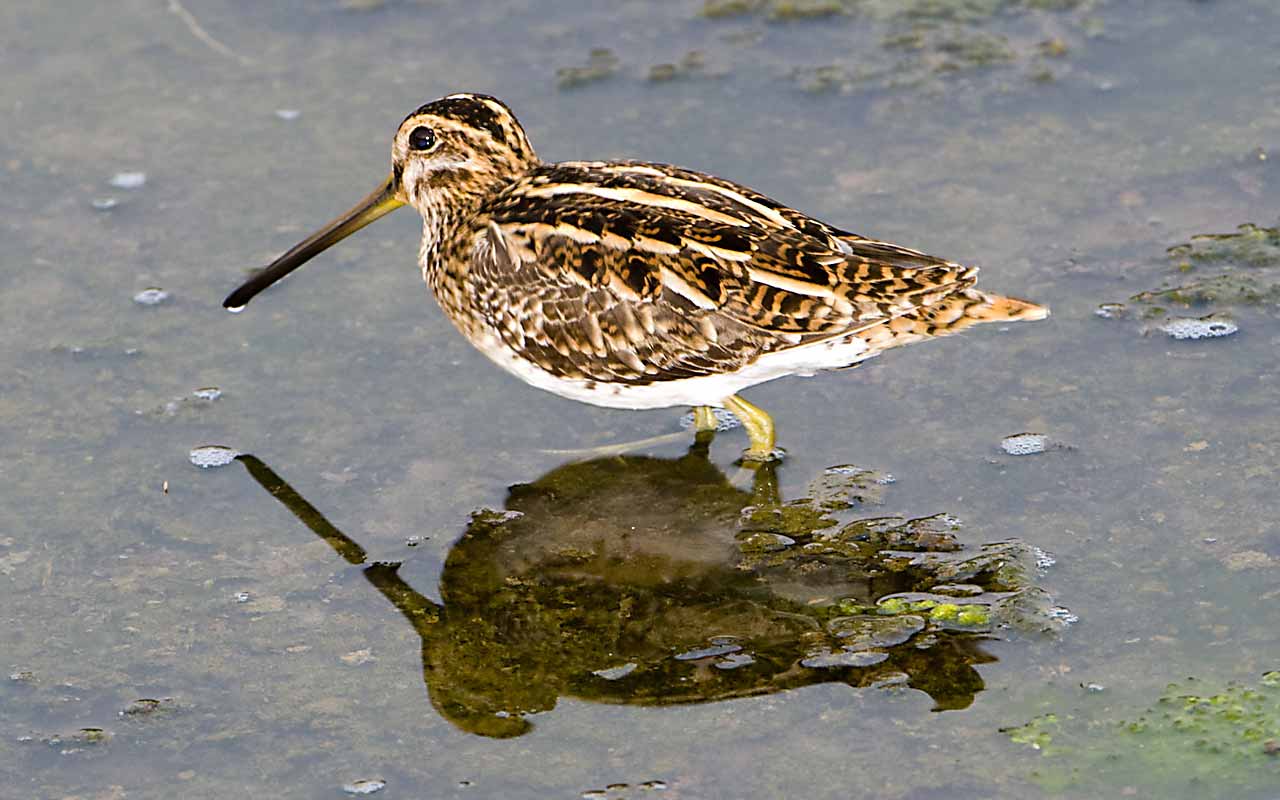
Yes, Virginia, you really can go Snipe hunting. A similar burst-from-the-ground escape tactic, but a more marshy habitat, different coloration, bill, etc. You'd have to be a really good shot... where do you think the term "sniper" came from, eh?


Saw this beautiful Bufflehead this spring on its migration northward. He was just chillin' on Taylor Lake (campus), but he must have been through a hunting season or two, for he took off as soon as he sensed my presence. With the help of a few friends, I figured out what I had seen.


Rails, like this Sora, are usually impossible to see, though you may hear them calling at the marsh, tucked away invisibly in the cattails. I scared one up and it only puttered away about 20 feet behind a couple cattails, allowing me a long gaze. Maybe I was right next to the nest? I did spot a cute all-black chick darting between some vegetation.


Again, I noted just a couple observations about color and behavior and the guidebook did the rest. Solitary Sandpiper, feeding on the exposed mudflats of a reservoir, southbound. Granted, this seemed to me more difficult in Bolivia, where you are faced with perhaps a half dozen varieties instead of, say, just two likely candidates.


Greater Yellowlegs. At the same mudflat I saw the sandpiper in. Another migrant.


Ok, I know these are birds that experienced birders picked up on their 3rd grade field trip, but it was fun to add a few to the list without even trying too hard. Luckily, my work puts me out of doors for hours at a time. Poor compensation, but this made up for it!

03 October 2013

INature: The Paw Paw (Asimina triloba)

Time to get your foraging on... it's paw paw time!

I just introduced a couple friends to this wonderful native tree (via some fruit); like many, they couldn't believe that it grew wild in Indiana. The paw paw is not difficult to spot. It has simple leaves nearly a foot long, with smooth edges ("entire margins," having no teeth). Like me, you might first confuse it at some distance with a hickory, which has compound leaves. The Paw paw is an understory tree than doesn't seem to grow much more than 30 feet tall. Whenever you see a paw paw, look around you - there are almost certainly several more plants, since they reproduce by root suckering more-so than seed production.

The paw paw feels a little out of place this far north. It produces the largest edible fruit indigenous to the U.S. and both the fruit and leaves seem "tropical." The soft fruit tastes something like a banana-mango custard. Yum! Wait to pick until they are feeling a little soft on the outside. If you have to pull very hard to get them off the tree, it's too early. If you do catch some unripe fruit, try leaving them at room temp for a few days. They might yellow a little bit upon maturation, but all the fruits I've found this year have been fully ripe and still very green looking. You should be able to peel off the skin with your bare hands, which can be discarded.


I have purchased young seedlings on eBay and both of them put out leaves the first year. If you, dear reader, are interested in planting some trees of your own, I have been savings dozens of paw paw seeds from this years crop. I have read here (Kentucky State U. Planting Guide) that are somewhat tricky to germinate, but it hurts nothing to try.  Please e-mail me if you'd like some seeds! However, this won't bear fruit for several years, nor will it likely be prodigious. But with this pleasant native oddity, the fruits are icing on the cake; you can forage for more paw paw patches in the meantime, carefully making notes for future harvests.


Of course the most important reason to forage paw paws is that it's yet another excuse to get out in the woods! I usually prefer the much higher chance of being "fruitful" with my paw paw "hunt" than the hours and hours I spent last fall waiting for venison. There are nearly 5,000 acres of woods where I work. From what I can tell nearly nobody even knows about them. That must be why I've hauled out several dozen fruits already!

But don't delay. It's a limited-time offer than won't return 'til our next lap around the star!


21 September 2013

INature: Parasites happen

Ok, 3 weeks behind already. Not sure if I'll have/make time enough to do this INature thing the way I'd like. Oh well...

Parasites are everywhere. Well... there are lots of mutualisms too & they don't get a lot of love, so let's not be too grim. But if it bleeds, it leads, right?

I found this splendid caterpillar near a marsh, munching on some Swamp Milkweed. With the aid of WhatsThatBug.com I found out that it was the Smeared Dagger Moth Caterpillar. Turns out to be a pretty nondescript moth, but I thought it's Latin name was neat: Acronicta oblinita.


I found another one a couple weeks later and decided to bring it home to my daughter.


We had previously cared for a Monarch chrysalis and watched it change from green to clear (it emerged while we were at church).


All was well for awhile. I had found it on a willow sprout and it munched away contentedly. Then we ran into some problems (sorry for the poor pictures... a perennial problem of mine).


I detailed them to WhatsThatBug.com:
... It stopped moving completely and even starting spinning a strange web. To my wife’s horror, dozens of small yellow parasites slowly emerged from its side as it was still (apparently?) alive. They all seemed to perish in the hot sun and the ants had a feast. Photo attached. I searched Google Scholar for some clues…
I see a 1903 reference to a ”Rhogas rileyi Cress” being parasitic, mentioning the silk I saw (p. 24 here: http://bit.ly/1atDh3W). However, I cannot find R. rileyi Cress in recent mention so I wonder if the name has been updated. I see a recent publication noting that the parasitic wasp Aleiodes rileyi Cresson often chooses A. oblinita as a host, but it did not seem to undergo the mummification described.

I received a prompt reply:

 ... in our opinion, the parasites that emerged from the Smartweed Caterpillar look more like fly larvae to us, so with that in mind, we would lean more toward this being an instance of parasitization by Tachinid Fly.  We have not been able to uncover any evidence, and that is just our first impression.  Perhaps one of our readers will have better luck determining What Parasitized the Smartweed Caterpillar?
So it was indeed a biology lesson... just not the one we expected! Raising caterpillars is supposedly quite simple. So far, we're about 1 / 5, and that was starting with a chrysalis.


29 August 2013

INature: Biodiversity

biodiversity (or "biological diversity")
    -the variety of life in the world or in a particular habitat or ecosystem
   -degree of variation of life forms within a given species, ecosystem, biome, or planet


Let everything that has breath praise the Lord. (Ps. 150:6)

.    .    .

I caught this bumblebee hovering over this unknown plant.
Considering biodiversity from a scientific perspective, it is the foundation for what we consider healthy, whole, natural systems. Biodiversity implies resilience, flexibility, complexity in the face of changing climates, invasive species, and stochastic events. If there are more species in the mix, it is less likely that any given event or change will fundamentally change or damage a particular system. The chestnut blight of the 20th century and Emerald Ash Borer infestation now spreading across Indiana are not to be celebrated, but the forests themselves will (generally) be okay in the long term. There are still many species of trees to provide cover, food, water filtration, and erosion control. Losing an entire forest to development or agriculture is far more detrimental than to lose a single species. This is why it is recommended that people plant a diversity of tree species in homes and public places. We cannot predict the next big disease, so we hedge our bets with biodiversity.

Besides all the birds and the bees that thrive in biodiverse systems, a human-centered, utilitarian perspective also shows that they are vitally important. They provide ecosystem services that we won't ever be able to fully engineer our way around. Natural cover (say, prairie or forest) allow much greater groundwater infiltration than bare agricultural soils, and certainly more than impervious surfaces. It also is worthwhile to point out the obvious: we chose from the incredible diversity of wild plants and animals to build a library of domesticated species for food, fuel, and fiber. Also, we know that we breathe out carbon dioxide, which photosynthetic organisms use as building blocks for sugars and such, spitting out oxygen as a by-product. Kind of handy, since that's what we need to breathe in every few seconds.

A thirsty butterfly licks up salt from my sweaty hand (I think)
Aesthetically and culturally, biodiversity is variety. It is "the spice of life." Vast fields of Zea mays may be beautiful to the indebted farmer, or the starving peasant, but we generally don't travel great distances to see even larger fields of a single species. We like variety, patchwork amalgams of colors and textures. Even the iconic images we hold of family farms (which have by-and-large been outdated for decades) show a diversity of animals, fields of multiple crops broken up by fence rows, ponds, outbuildings, and windmills.


And the diversity is stunning. 3.5 billion years of evolution, tectonic plates, climate change, and meteors have bequeathed us some 10 million species. We've only formally cataloged about 12% of that.


Another one of the 100,000+ kinds of insects native to N. America.
We have Monarch butterflies making a multi-generational migration from Canada to Mexico, sometimes over the Gulf of Mexico.

Black swallowtail (Papilio polyxenes) caterpillar found on our dill plant.
We have the Arctic tern, a 3.5 oz flying package of feathers who flies more in a single year as most American will probably walk in their lifetime - 44,000+ miles.

We have microorganisms deep in the Earth that will never see the sun, yet do just fine with chemosynthesis, earning a living straight from hydrogen sulfide.


North America used to be (until ~10,000 years ago) home to a cheetah, a lion, mammoths, horses, sloths and beavers the size of black bears, and a 9-foot-long sabertooth salmon.

If that doesn't get your blood moving, I'm at a loss at how to help. I'll just suffer the strange looks and go about my business.

Yeah, I know. It doesn't make sense.
The best way that I can think to celebrate this heritage is to name it, know it, explore it. 

In other words, to be like Adam.


Aldo Leopold wrote in his must-read book on ecological restoration, A Sand County Alamanac 
If I were to tell preacher of the adjoining church that the road crew has been burning history books in his cemetery, under the guise of mowing weeds, he would be amazed and uncomprehending. How could a weed be a book?
My effort here with "INature," and in my professional career and parenting, is to explore this vast natural library, book by book.


And like all great pursuits, this joyful enterprise is tinged with more than a bit of sorrow. Leopold also wrote:
One of the penalties of an ecological education is that one lives alone in a world of wounds. Much of the damage inflicted on land is quite invisible to laymen. An ecologist must either harden his shell and make believe that the consequences of science are none of his business, or he must be the doctor who sees the marks of death in a community that believes itself well and does not want to be told otherwise.
It's taken my about three decades to realize that bitterness, cynicism, and name-calling are no way to live, even if you happen to be right now and then. It's no way to do a family, or a church, or a business. I have to constantly remind myself of that. No matter where we are starting from, a better dawn is always possible.

Weeping may endure for a night, but joy cometh in the morning.  (Ps, 30:5)

And thankfully, the sun has risen for me over 10,000 times.


And now, time for my Plant Taxonomy lab...
 

19 August 2013

"INature": A new blog (series)

The blog wasn't dead, it was just dormant.

I'd like to cover little episodes of my wanderings in nature ("INature"), highlighting one natural process or species at a time, usually with a picture. Recently, I started some temp work in a natural setting, so I've lots of opportunities for these observations. They're a part of my job now. As long as I keep my eyes and ears working, I learn something every day. It's in the exchanges, questions, and ponderings that learning happens. There will be many unanswered questions... I'm counting on you to help me solve them!

If you want much better coverage of all things natural and Hoosier, you'd best check out Outdoor Indiana magazine. For each publication, they have a small write up one two Hoosier species, and I'd like to copy that feel.

So until I have time to sit down and write about the dozens of pictures I've already taken, I'll leave you with a marshy mystery...