25 December 2011

who said it? #141 the essence of all work

Bertrand Russell - the famously agnostic philosopher - said there are two kinds of work in this world: altering the position of matter on earth, and telling other people to alter the position of matter on earth.

From The Year of Living Biblically: One Man's Humble Quest to Follow the Bible as Literally as Possible by A. J. Jacobs (p. 80)

07 December 2011

pics from pampas jungle trip + article on Madidi Nat. Park

outlook of Rurre, main river, and mountains
Fearing that parenthood would greatly decrease my ability to continue adventuring (not that parenting isn't adventurous!), I (Adam) convinced Andy to bring his two older boys on a trip to the pampas near Rurrenabaque, on the edge of the magnificent Madidi National Park. The park itself protects land from the Amazon rainforest proper all the way up to the Andes mountains. We chose the budget-friendly pampas tour (insanely affordable for the value), instead of the actual rainforest, because you actually see more wildlife there.

orgullo en su pais
The tour was essentially water-based, centered around a humble river that cut through cattle-grazing land. Together with a German woman, a Swiss couple, and some Kiwis, we loaded our belongings into a long canoe with an outboard motor. We took our time getting to camp, stopping to look at wildlife along the way. Camp was a simple affair, with walkways and rustic cabins (shacks with blue tarps and not-quite-sealed mosquito nets) on stilts for when the pampas really gets flooded.

To avoid a lengthy commentary, I'll try to just list some of the things I remember. This was 1/2 a year ago already. All photos are credit Andy Baker - amazing photographer!

*an unsuccessful anaconda hunt. This means giving the gringos some wading boots and telling them to spread out throughout the swamp - yell when you see something. I was more interested in the new birds I saw...


*caiman nighttime hunt from the boat (shining lights at their eyes). Pepe was the camp croc, supposedly tame. I tried to keep my distance when they were tossing him meat.


trust me

*piraña fishing (we ate them for lunch)


*barefoot soccer and cold drinks with other guides and groups as the sun set over the pasture


*swimming with pink freshwater dolphins


you've got company

*howler monkeys waking us at 6 am sharp. The most other-worldly song I've ever heard. Turn up your speakers, close your eyes, and imagine you woke up to this, sleeping in the jungle, with no idea what it was:


a type of Capuchin monkey, much smaller than the Howler

*huge jarbiru stork nesting in a tree above our camp (these things are as tall as Becky + 8 ft wingspan)


*experiencing all of this 4- and 8-yr old boys. awesome!

The scariest moment was when one of our crew was rendered immobile/unresponsive by just 7 bites of tiny black ants. Crazy! Thankfully, he recovered.

It was quite the adventure, but we didn't hack deep into virgin rainforest or anything. Some people still do that... and it's not pretty. Here's an excerpt (warning: it's graphic) from Bugging Out - Into Madidid's Teeming Jungle: A Photographer's Journal by Joel Sartore (March 2000, National Geographic)
... Marcelo, our lead boat driver, tells a quick pig story as we pack up to leave.

We were hunting the chanchos (pigs) last year near the Rio Beni, not far from here. We saw a group of fifty. We killed Ten. This made them mad. They charged us. We ran and climbed trees. One of my friends didn't get high enough, and the chanchos pulled him down. We heard screams for a while, then waited to come down. When we found him, we found only pieces. Many pieces. We took the pieces of him to his parents' house. We were sad our friend had died such a terrible death."

Even the pigs can kill you here. A man Rosa Maria knows survived a pig attack but now has no butt. He didn't get quite high enough in the tree, and the pigs bit it all off...
...It's almost Christmas, and I'm more than ready to go home. I feel for the people here. Poverty abounds. Everything is worn out or broken. The kids in town swim in raw sewage. Rosa Maria points out that most of the world lives like this.

I know she's right. But I'm beat, and I just to sleep.
Now, if only the boro [live botfly maggot] in the back of my hand would do the same.

Editor's Note: Eight weeks after Sartore returned from a second trip to Bolivia, a wound on his lower right leg began to grow. He had contracted leishmaniasis -- caused by a flesh-eating parasite -- through the bite of a sand fly. The infection spread to his lymph system and created a hole in his leg the size of a silver dollar. The infection was eventually controlled by a combination of surgery and a 21-day intravenous treatment of an antimony compound. He'll know in ten years if he's fully cured.

06 December 2011

who said it? #139 Job, on what animals teach us

But ask the animals, and they will teach you,
       or the birds of the air, and they will tell you;

or speak to the earth, and it will teach you,
       or let the fish of the sea inform you.

Which of all these does not know
       that the hand of the LORD has done this?

In his hand is the life of every creature
       and the breath of all mankind.

(Job 12:7-10, NIV 1984)

21 November 2011

20 November 2011

who said it? #137 bird love, general and specific

When I was in college, and for many years after, I liked the natural world. Didn’t love it, but definitely liked it. It can be very pretty, nature. And since I was looking for things to find wrong with the world, I naturally gravitated to environmentalism, because there were certainly plenty of things wrong with the environment. And the more I looked at what was wrong — an exploding world population, exploding levels of resource consumption, rising global temperatures, the trashing of the oceans, the logging of our last old-growth forests — the angrier I became.

Finally, in the mid-1990s, I made a conscious decision to stop worrying about the environment. There was nothing meaningful that I personally could do to save the planet, and I wanted to get on with devoting myself to the things I loved. I still tried to keep my carbon footprint small, but that was as far as I could go without falling back into rage and despair.

But then a funny thing happened to me. It’s a long story, but basically I fell in love with birds. I did this not without significant resistance, because it’s very uncool to be a birdwatcher, because anything that betrays real passion is by definition uncool. But little by little, in spite of myself, I developed this passion, and although one-half of a passion is obsession, the other half is love.

And so, yes, I kept a meticulous list of the birds I’d seen, and, yes, I went to inordinate lengths to see new species. But, no less important, whenever I looked at a bird, any bird, even a pigeon or a robin, I could feel my heart overflow with love. And love, as I’ve been trying to say today, is where our troubles begin.

Because now, not merely liking nature but loving a specific and vital part of it, I had no choice but to start worrying about the environment again. The news on that front was no better than when I’d decided to quit worrying about it — was considerably worse, in fact — but now those threatened forests and wetlands and oceans weren’t just pretty scenes for me to enjoy. They were the home of animals I loved.

And here’s where a curious paradox emerged. My anger and pain and despair about the planet were only increased by my concern for wild birds, and yet, as I began to get involved in bird conservation and learned more about the many threats that birds face, it became easier, not harder, to live with my anger and despair and pain.

How does this happen? I think, for one thing, that my love of birds became a portal to an important, less self-centered part of myself that I’d never even known existed. Instead of continuing to drift forward through my life as a global citizen, liking and disliking and withholding my commitment for some later date, I was forced to confront a self that I had to either straight-up accept or flat-out reject.
Jonathan Franze, Technology provides an alternative to love (NYT op-ed)

I've been keeping track of my birding on my other blog...

30 October 2008

home early from the AT

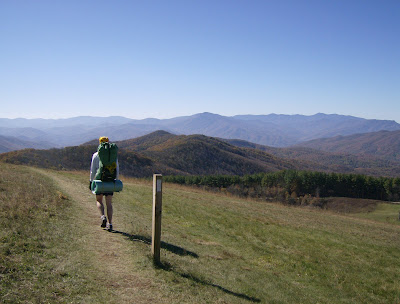
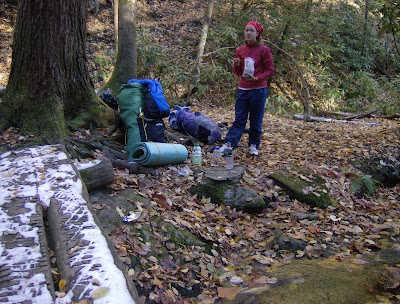
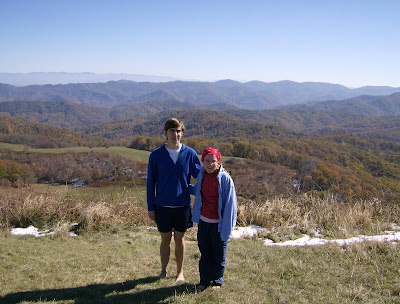
Maybe it was the flat tire in Kentucky (thank you, drill bit). Or perhaps the Ursus americanus that came tearing down the hill 20 yards ahead of us the first day (you might hike for weeks and weeks on the AT and never see a bear). Or the fact that we overestimated the temperatures by about 10 degrees (thank you, flatlander upbringing). Plus who knew how many half-drunk trigger-happy redneck hunters we might find in the bush? There's always a million reasons to quit, and 5 or 6 sufficed for us. Either way, we'd had enough after 2 1/2 days and 30 miles on the trail. Our legs felt great, but we certainly weren't emotionally ready at this point in our lives.

But it was really nice while it lasted. We had a couple great panoramic views, climbed our first mountains together, slept in bear country for the first time (taking rocks and sticks to bed), and got to field test our $400+ investment in new gear (thank you, birthday money). We extended our trip a day by swinging through Mammoth Cave on the way home. We spotted tons of tame deer strolling right through the campground and got to descend down a million-dollar staircase into the earth (I guess the going price for a submarine contractor to build underground is $3,000 per step).

From Appalachian Trail 2008

From Appalachian Trail 2008

From Appalachian Trail 2008

A couple more pictures + 1 video over here.

Below is all the meticulous backpacking details - what we took, how much it weighed, what happened each day. I post it here for my own future reference, but read along if you're nerdy or nosy: [notes in brackets]

Adam's pack - 13 lbs dry weight (no food or water)
Clothes/Main Gear:
*GoLite Gust Backpack - 1lb 4 oz [simple, light, strong; capacity is 30 lbs max; doubled as a pillow - internal pad provides enough cushion]
*Big Agnes Seedhouse Superlight 2 Tent - $201, 2lbs 14oz [worked fine]
*North Face Blaze Synthetic 20 degree sleeping bag - 3lbs 2oz [can go down to 25 degrees if I have pants, 2 fleeces, rain jacket, and hat on]
*Ridgerest 4' sleeping pad - $20, 9oz [Becky loved it]
*Cheap foam sleeping pad [provided little padding - get another Ridgerest]
*$1 fall gloves [wear out fast, not rain proof, but help keep me comfortable]
*New Balance 473 [not picky with shoes, prefer trail running ones]
*Generic nylon rain coat [my $200 North Face coat is heavy and doesn't shed water; this was light, cut wind, but wasn't rain tested - I sprayed water repellent on all gear and clothes]
*3 pair socks [might have gotten by with 2, but make sure they are different thickness for variability]
*2 fleeces [didn't throw in the 2nd one until I got scared by another hiker's tale of a recent 4" snow blizzard in the Smokies. I'm glad I did - I slept with all my clothes on and was just on the edge of sleepability, though I never wore two fleeces while hiking, even at 30 degrees]
*1 long sleeve sweat-wicking shirt [not sure if I ever took it off in 3 days :) ]
*thin nylon pants
*running shorts w/ netting
*hunter orange acrylic stocking cap [wear during hunter season - critical for heat retention too]
*yellow cotten bandana [barely used it; usually cold enough to need stocking cap, but bandana would keep hair out of face in warmer temps]
*large black plastic trash bag [rain protection + bear bag to put food in tree]
*30' nylon rope [to put food out of bear's reach - also used to strap sleeping pads underneath pack]
Cooking: [not cooking is lighter/faster, but cooking adds a psychological boost by providing a treat to look forward to and expands menu options. Items carried in grocery sack, which quickly tore]
*HEET fuel additive [plan for about 3oz/day], cooking pot, cigarette lighter, old vienna sausage can + small chicken wire fence as stove set, liquid soap for clean-up, 2 plastic spoons in bag, sponge [the thin scraping part]
Toiletries (in a ziploc):
*1 mini-bottle bleach [2 drops/quart for water purification], 1 roll T.P. per wk for us 2 [probably need just 3/4 roll], 1.3oz body glide lubricant, 4 sheets moleskin, duct tape [wrapped around HEET bottle], 1 bar hotel soap, moisturizer w/ SPF, chapstick, comb, hand-sanitizer, perfume, 2 toothbrush heads [take a full 1/2 of a toothbrush next time], disposable razor, 30-some ibuprofen, alcohol swabs, band aids, triple-antibiotic, cotton balls, anti-diahreal meds.
Office/Other (in a ziploc):
*1 car key, digital camera w/ batteries [bring good ones + spares], cash, ID, debit card, 2 pens (just the ink part), 3 pages of Bible, 6 pages trail data, plastic emergency whistle/compass [a light last-minute addition that was lying around], 2 velcro straps, 1 large rubber band, 2 small pieces of string [didn't use, though might come in handy], 1 42-oz plastic bottle and 1 20-oz plastic bottle [42oz worked well for mixing one giant shake and share; having a few 20oz bottles helped us distribute weight more evenly, even pinning one to my chest by my chest strap - that's 1.25 lbs off my back, counterbalanced to the front!]

Forgot to take:
*safety pins [to hang drying socks, though I improvised]

Should not have taken:
*
Couldn't find too much to leave behind. Some stuff was not used, but we weren't out very long and nothing got rain-tested. After seeing how heavy some other packs were, we certainly value packing "light" but I'm not going to compromise a trip to save a pound or two. Most weight is saved in the Big 3 - shelter, bag, and pack, all of which we've made fairly good low-weight investments in (just over 7 lbs if I carry the whole tent).Becky's pack - 8 lbs [our total dry weight was just 21 lbs - hiking in pairs really cuts down weight and allows it to be shifted, depending how all are feeling. Since I outweighed Bec by 70 lbs, I took both our pads, the tent, cooking, toiletries, and our big water jug]
*GoLite Jam 2 Pack (small) - approx. $80, 1lb 5 oz. [boy this was small, but it forced us to take little and let Adam carry the rest
*North Face Tigger 20 degree Climashield Child's sleeping bag - $80, 2lbs 1 oz [This was great! Since Bec is tiny and kid's bags fit persons up to 5', we took a risk and ordered this one. She fits fine, it cost about 50% less than comparable woman's bag, packs smaller, and sheds at least 1/2 a pound - just what we needed for her tiny pack!]
*other stuff that she took ... don't have record now.

Itinerary + Highlights:
*Night 1: Hot Springs, NC (elevation 1,326') just off the trail. 30 degrees or lower.
*Day 1: 13.1 miles, finished in 8.25 hrs. 1-2" snow on N side of mountains. Saw black bear running across trail 20 yds away at 10 miles.
*Night 2: Walnut Mountain Shelter (~3,800-4,000'). Cold and windy, 30 degrees or lower. No water all day and none tonight. Slept with 4 other thru-hikers (southbound). Company was a large psychological boost.
*Day 2: 13.1 miles, finished in 8 hrs. Finally found water after 1 hr or so. Incredible view at the bald on Max Patch Summit (4,629').
*Night 3: Camped alone at Groundhog Creek Shelter (2,900'). Warmer, no snow on ground, but deserted. Water supply not running, but looked clear (we drank). A little creepy and very quiet. Woken by the screech owls.
*Day 3: 7.2 miles. Hiked to Standing Bear Farm Hostel and saw Curtis, the owner (we miraculously ran into him at a diner our morning in Hot Springs before we hiked a mile!) He was busy so we called outfitter in Hot Springs to send a shuttle.

09 December 2006

life goals / bucket list

These escaped my brain the other day (updated Jun. '12):

*(new)Visit Isle Royale National Park, a remote island-park in Lake Superior with bears, wolves, and moose
*(new)Visit Magee Marsh during spring warbler migration


*get on a boat in the ocean to the point where I can't see land at all
*read 1,000 books
*climb a 6,000m mountain peak
*visit the Galapagos islands
*hug General Sherman 
*visit Jason deCaires Taylor's underwater coral statues
*hike the 100-mile wilderness in Maine
*own and read all the works of Wendell Berry
*live one month out of a backpack along a trail
*live one day without water
*live one day without hearing human words
*let someone else (other than my wife) make an important life-decision for me (moving, children, job)
*own and care for a cow or goat or lamb

*hunt a wild animal, then slaughter, cook, and eat it (Fall 2013, duck hunting at Salamonie Reservoir)


*live one year without a personal vehicle (achieved by Aug. '11, well 11 months or so)
*be a father to a child (achieved by Aug. '11)
*live two years in an intentional community (move for the people, not the job) (achieved Jan '12, WMF community in El Alto, Bolivia, sorta)
*live one day without speaking (achieved Dec, '10, 36 hours of silence near Lake Titicaca, Bolivia)
*get a tattoo (achieved July, '10, Love Tattoo, Jenison, MI)
*live in a city of 500,000+ people (achieved Jan '10, Cochabamba, Bolivia)
*live somewhere where I am the minority (race, gender, income level, religion) (achieved Jan '10, Cochabamba, Bolivia. race, gender, income level, religion)\
*get in the crowd of the Colbert Report (no longer possible, ended in 2014)

Kind of long shot, interesting tings:
*swim between continental plates at Iceland's Thingvellir Lake (silfra)